Bag Carton Volume and Chargeable Weight: How Packing Changes Your Shipping Cost
Bags are light but bulky, which makes them a classic case for volumetric pricing. A carton of structured handbags can weigh little and still be billed as if it were much heavier. Understanding how carton size turns into chargeable weight helps you read freight quotes and decide when a packing change is worth it. This guide is based on the carton volume and chargeable weight guide published by 1688 Bags.
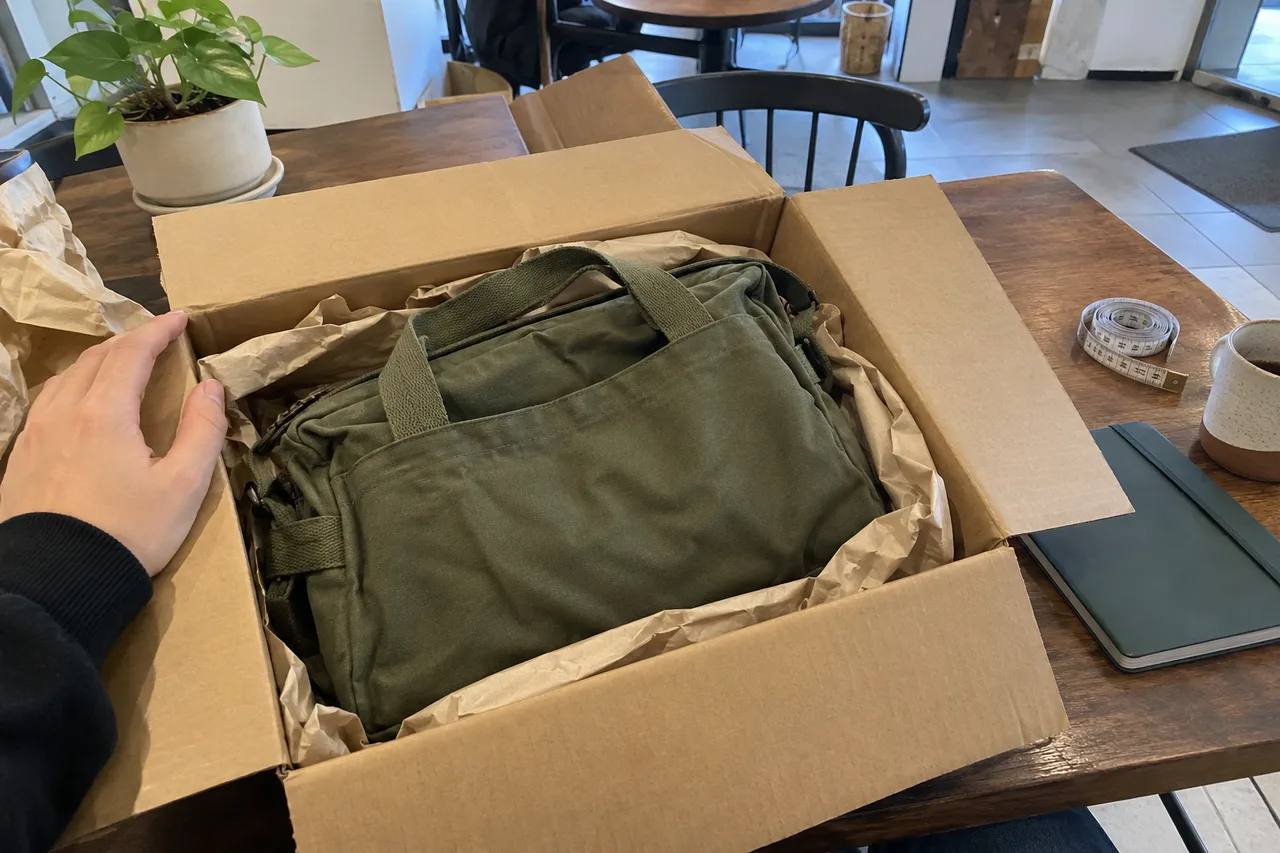
AI-generated illustration of an olive bag in an open shipping carton beside packing paper and a tape measure. Image: 1688bags.com.
Listing dimensions are not shipping dimensions
The first trap is using the bag's size from the listing. The site points out that stuffing, handles, protective sleeves, retail boxes, separators and the outer carton all change the final package. What matters is the sealed carton after the agreed packing is done.
When you get the measurement, it should record the largest external length, width and height, including bulges where the carrier's method requires them, and the gross weight of the complete package including carton and packing materials. Save the carton ID, the units inside and a photo of the packed carton. Early figures based on listing data are estimates and should be labelled that way.
Two formulas that answer different questions
The guide separates two calculations that are often confused:
- Carton volume in cubic meters = length × width × height ÷ 1,000,000 (with dimensions in centimeters). This describes space.
- Dimensional weight in kilograms = length × width × height ÷ the applicable divisor. This is a billing convention.
Keep units visible. Centimeters, inches, kilograms and pounds cannot be mixed in one formula without conversion, and a divisor only has meaning together with its measurement and weight units.
A worked example
The site's example carton measures 60 × 40 × 35 cm and weighs 12 kg.
- Volume: 84,000 cm³, or 0.084 m³.
- Dimensional weight at a 5,000 cm³/kg divisor: 16.8 kg.
- Dimensional weight at a 6,000 cm³/kg divisor: 14 kg.
For many parcel services the higher of actual and dimensional weight is the starting point for billing, so this 12 kg carton could be billed on 16.8 kg or 14 kg depending on the service. The guide cites DHL's Singapore guide, which describes a typical DHL Express calculation in centimeters with a 5,000 divisor, and FedEx's Australia FAQ, which also gives a 5,000 divisor and says to round dimensions up to the next centimeter. It cautions that these support the method, not the assumption that every service uses the same rule. Read the terms for the actual service quoted.

Illustration of the repacking step where bags are placed into export cartons. Image: 1688bags.com.
When a packing change pays off
The guide's second example shows why packing matters. A hypothetical 50 × 40 × 30 cm carton that can safely become 50 × 40 × 25 cm after an approved packing change drops from 0.060 to 0.050 m³. At a 5,000 divisor, dimensional weight falls from 12 kg to 10 kg.
That saving is real, but the guide asks you to identify what is removed or compressed before approving it. A structured bag may need support to keep its shape. Hardware may need separation to avoid rubbing. Removing a presentation box may affect how you sell the bag. Ask for a revised packing photo, measurements and gross weight before deciding. The bag QC inspection checklist includes shape deformation and packing compression as topics where before-and-after packing photos help.
Multi-carton and multi-seller shipments
For several cartons, list each one's dimensions and weight and ask whether the service calculates chargeable weight per package or at shipment level, and how rounding is applied. Adding raw volume first can produce a different result. The multi-seller consolidation guide gives an example: two cartons of 40 × 30 × 30 cm and 5 kg each come to 7.2 kg dimensional weight each, 14.4 kg in total at a 5,000 divisor, before billing rounding. Compare that against one consolidated carton on the same service, with identical contents and destination.
When you request a quote, the guide suggests asking for: destination and postcode; the service or route proposed; carton IDs; units per carton; external dimensions and units; gross weight and units; the divisor; measurement and weight rounding; whether calculation is per package or per shipment; and included charges and exclusions. These feed directly into the DDP bag shipping review and the bag sourcing pricing worksheet. You can also try your own numbers in the landed cost estimator.
A practical routine for each order
Put the steps together and a routine emerges. Agree packing requirements first: what may be folded, what must keep its shape and which retail packaging stays. Ask for the sealed carton's measurements, gross weight and a photo once packing is done. Apply the quoted service's divisor and rounding to get chargeable weight, and compare it with the actual weight. If the difference is large, ask whether a safe packing change would reduce it, and review the revised photo before approving. Only then compare routes. The site's calculator on the guide page is prefilled in centimeters and kilograms and notes that it gives a weight basis, not a freight quote, which is the right way to treat any figure before the route is confirmed.
FAQ
Why is my light bag order billed as heavier?
Many services bill on the higher of actual and dimensional weight, and bulky bag cartons often have a higher dimensional weight.
Which divisor should I use?
The one stated by the service quoted. 5,000 cm³/kg is common in the cited examples, but rules differ by service and region.
Should I always remove retail boxes to save volume?
Not automatically. Check shape protection, hardware rubbing and how you plan to sell the bag first.
Send your packing requirements, including what may be folded or removed, through the sourcing request page.
Contact 1688 Bags: email sales@1688bags.com · 1688bags.com